
Secure your ad revenue with the IAB TCF v2.3
Effortlessly adopt TCF v2.3 using our IAB-certified consent management platform and stay proactive in managing compliance risks. Pandectes is a certified IAB TCF v2.3 CMP.
What is the IAB Transparency and Consent Framework?
The Transparency & Consent Framework (TCF) is a functional framework created by the Interactive Advertising Bureau (IAB) Europe. It assists website owners, publishers, vendors, and advertisers in adhering to the GDPR’s transparency and consent requirements.
TCF standardizes the process of obtaining user consent for the processing of personal data within the digital advertising ecosystem. Initially introduced in 2018, the IAB has released several updates, with the most recent, version 2.3, being launched in February 2026.
Who does IAB TCF impact?
Publishers
Vendors
Third-party advertisers who collaborate with publishers such as yourself can legally process personal data for online advertising and associated activities.
Why you should use a CMP that integrates with the IAB TCF
- Meet the required legal standards for data protection
- Serve ads in the EU, EEA, and UK
- Build trust with end-users
- Generate ad revenue confidently
Pandectes CMP features that enable IAB TCF compliance
- Included in the List of Google-Certified CMPs
- Easy to set up IAB TCF v2.3 integration
- Easy consent withdrawal procedure that aligns with IAB TCF v2.3 requirements
- Supports Google Additional Consent to compliantly work with non-GVL advertisers
- Enables you to obtain and record valid user consent for data processing purposes
Pandectes CMP consent banner features for IAB TCF compliance
- Detailed vendor disclosure on the cookie consent banner
- Standard, non-editable, IAB-certified message displayed in the banner
- Customization available for you to display your own link to your privacy policy or cookie policy
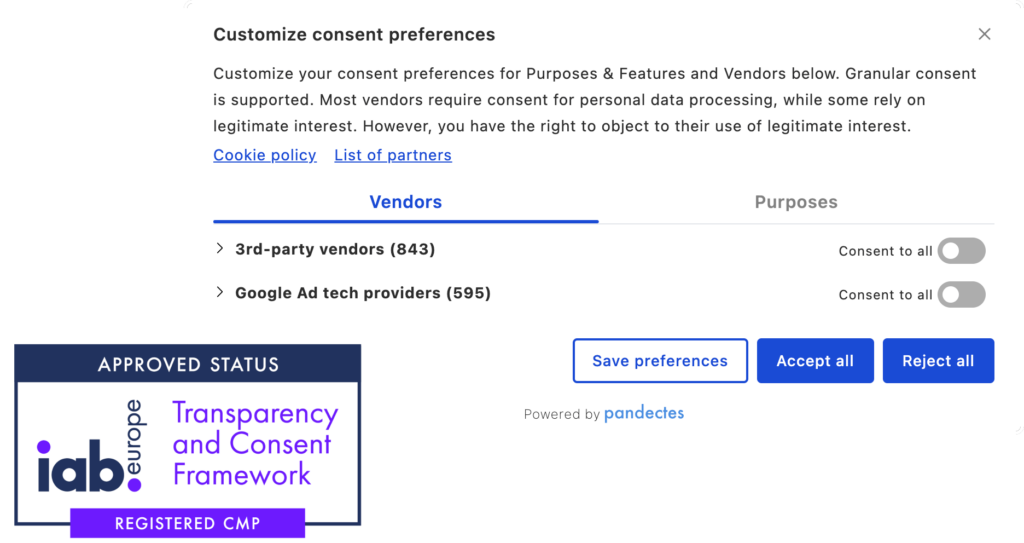
- Ad settings tab for consumers to choose between IAB purposes and vendors before submitting their consent
- Total number of parties data will be shared with is displayed on the first layer of the banner
FAQs
IAB Europe, the regional association of the Interactive Advertising Bureau (IAB), supports the digital marketing and advertising ecosystem. It comprises national IABs and various marketing, media, and technology companies. The mission of IAB Europe is to provide political representation and foster industry collaboration through the development of frameworks, standards, and programs that help businesses prosper in the European market.
The main change in TCF v2.3 is that the Disclosed Vendors segment is now mandatory rather than optional. This update requires every transparency and consent string to include a binary signal proving whether each specific vendor was actually shown to the user in the cookie banner interface. By making this field required, the framework provides technical proof to ad vendors and platforms like Google that they were properly disclosed before any data processing occurs. This transition moves the industry from a policy-based model to a technical verification model to reduce ambiguity and ensure compliance with strict data regulations. While this is a significant technical update for your CMP, it does not require visual changes to your banner design or a forced re-consent of your existing users.
Yes, TCF 2.3 is mandatory for any publisher or merchant using the IAB Transparency and Consent Framework. The industry deadline for implementation is February 28, 2026. Starting March 1, 2026, any newly generated consent strings must follow the v2.3 technical specifications to be recognized as valid by ad vendors and platforms like Google and Microsoft. If a store fails to provide a valid TCF 2.3 signal after this date, it may result in "Limited Ads" status, which significantly reduces ad personalization and revenue. For users of a Google Certified CMP like Pandectes, this update is handled automatically at the system level, meaning no manual action or forced re-consent of existing visitors is required to remain compliant with the mandatory standard.
The official deadline for the transition to IAB TCF v2.3 is February 28, 2026. Starting March 1, 2026, all new transparency and consent strings generated by a consent management platform must follow the v2.3 technical specifications to be considered valid by ad vendors and platforms like Google and Microsoft. This means that as of tomorrow, any newly collected consent must include the mandatory disclosed vendors segment. Consent strings collected under the previous v2.2 format before this deadline remain valid until they naturally expire or the user changes their preferences, so there is no need to force a re-consent or resurface the banner to existing users. As a Google Certified CMP, Pandectes handles this transition automatically for all merchants, ensuring no disruption to ad revenue or compliance status.
If your business monetizes through online ads, you're acting as a publisher and require a Google-certified CMP like Pandectes, supporting IAB Europe's TCF v2.2.
Gathering user consent for ad-related data processing is essential. Pandectes facilitates clear communication about data usage and offers easy consent management.
1. Adopt IAB's TCF v2.3 for a standardized approach to vendor collaboration, minimizing data privacy risks and ensuring compliance with GDPR and ePrivacy Directive.
2. Publishers and developers using Google AdSense, Ad Manager, or AdMob to serve ads in the EU/EEA or UK must have a Google-certified CMP that integrates with IAB’s TCF v2.3.
3. Utilize Google’s Additional Consent to manage and signal consent for ad tech providers not covered by IAB Europe’s TCF v2.3, but included in Google’s Ad Tech Providers (ATPs) list.
Actually, TCF 2.3 is designed to protect your ad revenue. It does not limit it, provided you meet the implementation deadline.
How TCF 2.3 affects revenue:
- Prevents "Limited Ads": If you do not upgrade by February 28, 2026, ad platforms like Google will view your consent signals as invalid. This forces ads into "Limited Ads" mode, which can drop your revenue by 50% or more because ads are no longer personalized.
- Increases Bidder Confidence: Premium advertisers are more likely to bid on your store's inventory when they have "mathematical proof" (the new v2.3 disclosure signal) that they were properly shown to the user.
- No Impact on User Experience: Because TCF 2.3 is a technical update to the data string, it doesn't require a change to your banner's design or a new consent request from your customers. This means your current opt-in rates should remain stable.
- Minimizes Compliance Risk: By using the latest framework approved by the IAB and Google, you reduce the risk of being flagged for non-compliance, which could lead to being blocked by major ad networks entirely.
In short, TCF 2.3 is a "safety net" for your monetization. It ensures that the consent you collect is technically valid so that you can continue earning at full capacity.