
 Install free
New Hampshire Privacy Act (NHPA)
Explore how the NHPA enhances data privacy for New Hampshire residents and ensures businesses comply with transparency and accountability standards.
Start Free
The #1 cookie consent app for Shopify, trusted by 195k stores


What is NHPA?
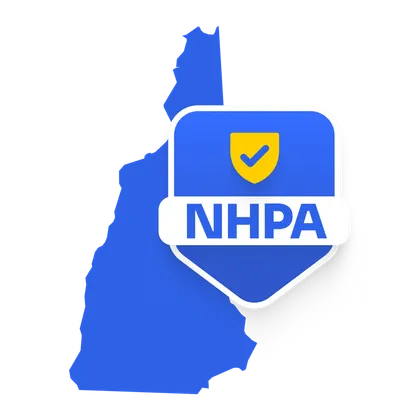
The New Hampshire Privacy Act (NHPA) is New Hampshire’s comprehensive consumer privacy law. It was signed in March 2024 as Senate Bill 255 and added as Chapter 507-H of the New Hampshire Revised Statutes.
Under the NHPA, New Hampshire consumers have the right to:
- Confirm whether a business processes their personal data and access it
- Correct inaccuracies in their personal data
- Delete personal data provided by or obtained about them
- Obtain a portable copy of the personal data they provided
- Opt out of targeted advertising, the sale of their personal data, and profiling that produces legal or similarly significant effects
The law also defines sensitive data, which includes racial or ethnic origin, religious beliefs, health diagnoses, sex life or sexual orientation, citizenship or immigration status, genetic or biometric data used to identify a person, precise geolocation, and personal data collected from a known child.
Who does the NHPA apply to?
The NHPA applies to businesses that conduct business in New Hampshire or target products or services to New Hampshire residents and, in a one-year period, either control or process the personal data of at least 35,000 consumers (not counting data processed only to complete a payment), or control or process the personal data of at least 10,000 consumers and derive more than 25% of gross revenue from selling personal data.
Government bodies, financial institutions subject to the Gramm-Leach-Bliley Act, HIPAA covered entities and business associates, nonprofits, and institutions of higher education are among those exempt. The law also does not cover people acting in a commercial or employment context, such as employees or business contacts.
What happens if I don’t comply with the NHPA?
The New Hampshire Attorney General has exclusive authority to enforce the NHPA. The main points are:
- Cure period: until December 31, 2025, the Attorney General had to offer 60 days to cure a violation. Since then, offering a chance to cure is at the Attorney General’s discretion.
- Penalties: a violation is an unfair or deceptive act under the New Hampshire Consumer Protection Act, with civil penalties of up to $10,000 per violation.
- No private right of action: consumers cannot sue a business directly under the law. They can file a complaint with the Attorney General.
When did the NHPA go into effect?
The NHPA took effect on January 1, 2025, and businesses have had to honor universal opt-out signals such as Global Privacy Control since then. Businesses that meet its thresholds must comply now.
Complying with the NHPA
If the NHPA applies to your online store, the work that matters most for cookies and tracking looks like this:
- Offer an opt-out of targeted advertising and sale. Advertising pixels and tags that track visitors across other websites are typically targeted advertising. If you sell personal data or use it for targeted advertising, you must clearly disclose this and explain how consumers can opt out. A visible opt-out link and a cookie banner with clear choices are the usual way to do this. You must also honor universal opt-out signals such as Global Privacy Control.
- Get opt-in consent for sensitive data. You must not process sensitive data, such as precise geolocation, without the consumer’s consent. Data collected from a known child must be handled under the federal Children’s Online Privacy Protection Act. For consumers you know are 13 to 15, you also need consent before targeted advertising or selling their data.
- Publish a clear privacy notice. It must describe the categories of personal data you process, why you process it, the categories you share with third parties, and how consumers can exercise their rights and appeal your decisions.
- Handle consumer requests on time. Provide at least one secure and reliable way to submit requests, without requiring a new account. Respond within 45 days, extendable once by another 45 days when reasonably necessary, and answer appeals within 60 days.
- Keep collection to what you need. Limit personal data to what is adequate, relevant, and reasonably necessary for the purposes you disclose, and protect it with reasonable security practices.
To make this easier, consider a Consent Management Platform (CMP) like Pandectes GDPR Compliance. It is built for Shopify stores and provides a cookie banner with opt-out options for US states, a “Do not sell or share my personal information” link, automatic cookie scanning and classification, a cookie declaration, consent logs, and data subject request handling. Region-specific banner settings let you show New Hampshire visitors the right experience based on their location.
Every business is different, so review your obligations under the NHPA with legal counsel where appropriate.