Starting 27 September 2026, every online store selling physical goods to consumers in the EU has to show a new, standardized notice about the buyer’s legal guarantee rights. It needs to appear before the order is placed, not buried in the Terms & Conditions. Some products will also need a second, separate label called GARAN. There is no grace period. The rule applies the moment the clock hits that date, in every EU member state, to every seller reaching EU shoppers, regardless of where the store itself is based.
If you run a Shopify store and sell to EU customers, this affects you. Here is what the law actually requires, who it applies to, and what to do about it before the deadline.
What is the EU Legal Guarantee Notice?
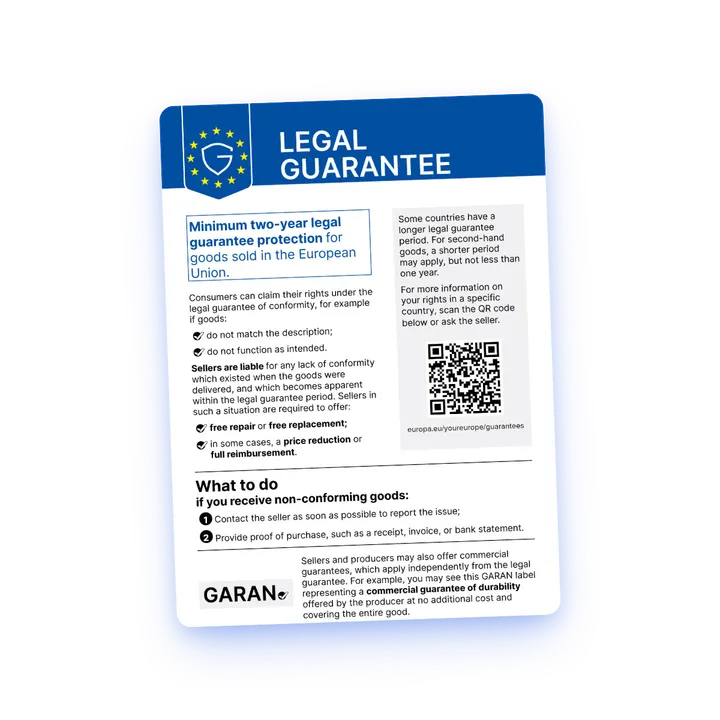
The Legal Guarantee Notice is a mandatory, standardized notice that reminds shoppers of a right they already have under EU law. When they buy goods from a business in the EU, those goods come with a legal guarantee of conformity, generally a minimum of two years. National law in some member states extends that further, and certain second-hand goods may carry a shorter agreed period of no less than one year. If a product turns out faulty, doesn’t match its description, or doesn’t work as promised, the seller has to offer a remedy: typically a free repair or replacement, and in some cases a price reduction or full refund.
That right already exists. What changes on 27 September 2026 is that sellers must now actively tell shoppers about it, using one fixed, official design, before the shopper commits to buying.
The notice is not something you design yourself. The European Commission publishes the finished artwork as SVG, PNG and JPG files, in all 24 official EU languages, and the rule is simple: download the correct language version and place it, unedited. None of its text, layout, or colors can be changed.
What is the GARAN label, and is it mandatory?
GARAN is a separate, look-alike label for a different kind of promise: a commercial guarantee of durability that a producer voluntarily offers on top of the legal minimum, for example “5 years free of charge.”
Offering that kind of guarantee is entirely optional for a producer. But once a producer does offer one, and it meets four conditions, displaying the GARAN label for that specific product stops being optional for the seller:
- It’s offered free of charge to the consumer.
- It covers the entire product, not just one component.
- Its duration is more than two years.
- The producer has made the guarantee information available to the seller.
If a guarantee doesn’t clear all four bars (say, it’s a 2-year guarantee, or it only covers the battery), no GARAN label is required for that product. Sellers also aren’t expected to go digging for guarantee details on a manufacturer’s website; the Commission’s own guidance is clear that the initiative lies with the producer. But once that information does arrive, the display obligation is triggered, and a seller can’t sidestep it simply by not advertising the guarantee.
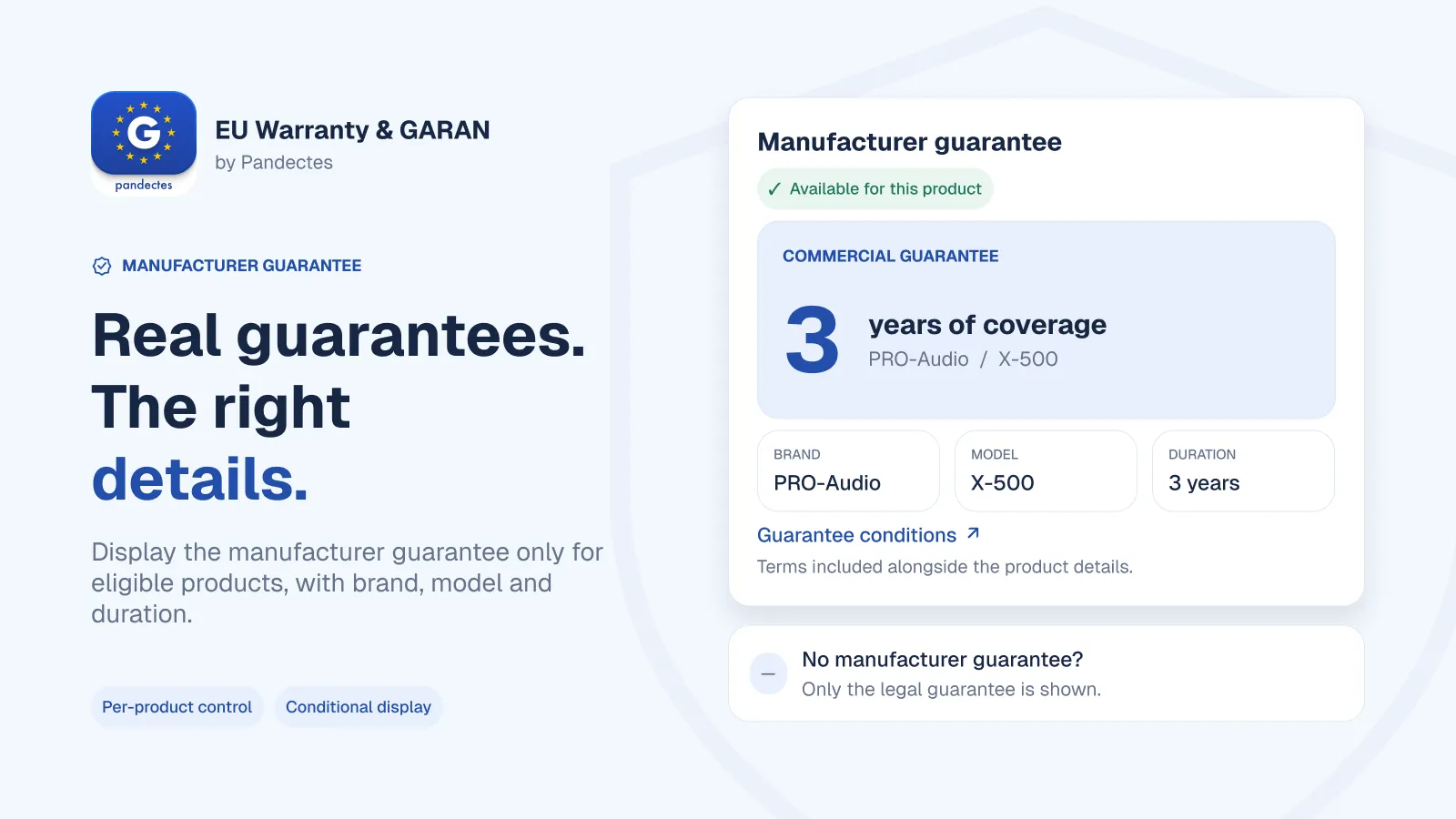
Like the legal guarantee notice, GARAN comes as a fixed official template. The only parts you’re allowed to fill in are three fields: the duration in years (whole years or half-years only, so 3, 5, or 2.5, for example, but not other decimals), the producer’s brand or trademark, and the model identifier.
Who does this actually apply to?
Every trader selling goods to consumers in the EU, regardless of company size, sector, sales channel, or where the business itself is based. A one-person Shopify store in the US shipping to Germany is covered exactly the same as a large EU retailer. The obligation reaches every consumer-facing sales channel: your own online store, marketplace listings, and physical retail, wherever applicable.
For a Shopify merchant, in practice this means: if any of your customers can check out from an EU address, this law applies to your store, whether or not you’re headquartered in the EU.
Digital goods, gift cards, and pure services fall outside the legal guarantee of conformity, since that’s a goods-specific right, and the notice isn’t required for B2B transactions either, because it’s a consumer-protection rule. If your store sells a mix of physical products and other things, the notice only needs to apply to the physical goods.
Where does the notice actually have to appear?
The legal test is simple to state and easy to get wrong in practice: the notice must be shown “in a conspicuous manner, before the consumer is bound by the contract.” The regulation defines exactly what the notice looks like. It says nothing about which page it has to sit on, as long as it’s genuinely seen before checkout completes.
The European Commission’s own guidance points to a layered approach that works well for an online store:
- A permanent entry point at shop level, such as a header link or standing element, since the legal guarantee applies to everything you sell, not just one product.
- On the product catalogue or category page, reachable without a click.
- On the product page itself, where a shopper comparing options will actually look. It’s also the natural home for a GARAN label, next to the specific model it covers.
- At checkout, before the order is placed. This is the strongest position, because it removes any doubt about whether the notice was seen “before the consumer is bound.”
- In the order-confirmation email. Article 8(7) of the Consumer Rights Directive already requires certain pre-contract information to reach the buyer on a durable medium, and the Commission’s practical guidelines recommend including both the notice and any applicable GARAN label there too.
The one placement that does not count: parking the notice only in your Terms & Conditions or a footer link nobody clicks. That’s explicitly called out as the most common mistake, and, unsurprisingly, the one most likely to attract attention once the deadline passes.
The design rules, briefly
You won’t be drawing this yourself, but it’s worth knowing what “correct” looks like, especially if a theme customization ever touches it:
- Online: full color (RGB). A clickable link to the same destination as the QR code is required, since a QR code is useless to a shopper who’s already looking at the page on the device they’d scan it with.
- Typeface: Inter. (If that name looks familiar, it’s the same typeface this site is built on.)
- Official colors only: Reflex Blue (
#003399), Yellow (#FFED00), Black, and White, exactly as issued. - The correct language for the storefront. A merchant selling into several EU countries needs the matching local-language version on each storefront, not one English master everywhere. GARAN’s multilingual footer, which translates “producer guarantee in years” into every official EU language, is a fixed element and can’t be removed.
- Nothing altered beyond GARAN’s three editable fields. No cropping, stretching, recoloring, or “close enough” recreations. A homemade look-alike isn’t compliant, even if it looks right.
What happens if you don’t comply
The regulation that fixes the notice and the label’s design, Commission Implementing Regulation (EU) 2025/1960, is short: three articles and two annexes. It doesn’t set penalties itself; enforcement runs through each member state’s own consumer-protection law.
Two distinct risks are worth separating:
- Coordinated EU-level fines apply to widespread infringements: patterns of non-compliance affecting multiple member states, pursued through the EU’s cross-border enforcement mechanism (Regulation (EU) 2017/2394). Where that threshold is met, national frameworks can set fines up to a percentage of annual turnover, with country-specific ceilings and figures. This is the mechanism behind the “4% of turnover” number that circulates around this law. It’s a ceiling for coordinated, widespread cases, not the standard fine for one missing notice.
- Cease-and-desist claims from competitors and consumer associations don’t need to clear that “widespread” bar at all. A single store with a missing or non-compliant notice can be targeted individually, and because the notice and label are so visible, the first such letters are widely expected within weeks of the 27 September deadline.
The second risk is the more immediate one for most Shopify merchants. It doesn’t require a regulator to notice you, only a competitor or a consumer group browsing your checkout page.
A quick compliance checklist
- The Legal Guarantee Notice is visible somewhere a shopper will actually see it before checking out, ideally the header and the checkout page.
- It’s the official, unedited artwork, in the correct language for each storefront.
- For any product with a qualifying producer guarantee, the GARAN label is on the product page, with the three fields (duration, brand, model) correctly filled in.
- Both are included in your order-confirmation email.
- Digital products, gift cards, services, and B2B checkouts are correctly excluded.
- You’ve checked this per storefront if you sell into more than one EU country.
How Pandectes EU Warranty & GARAN helps
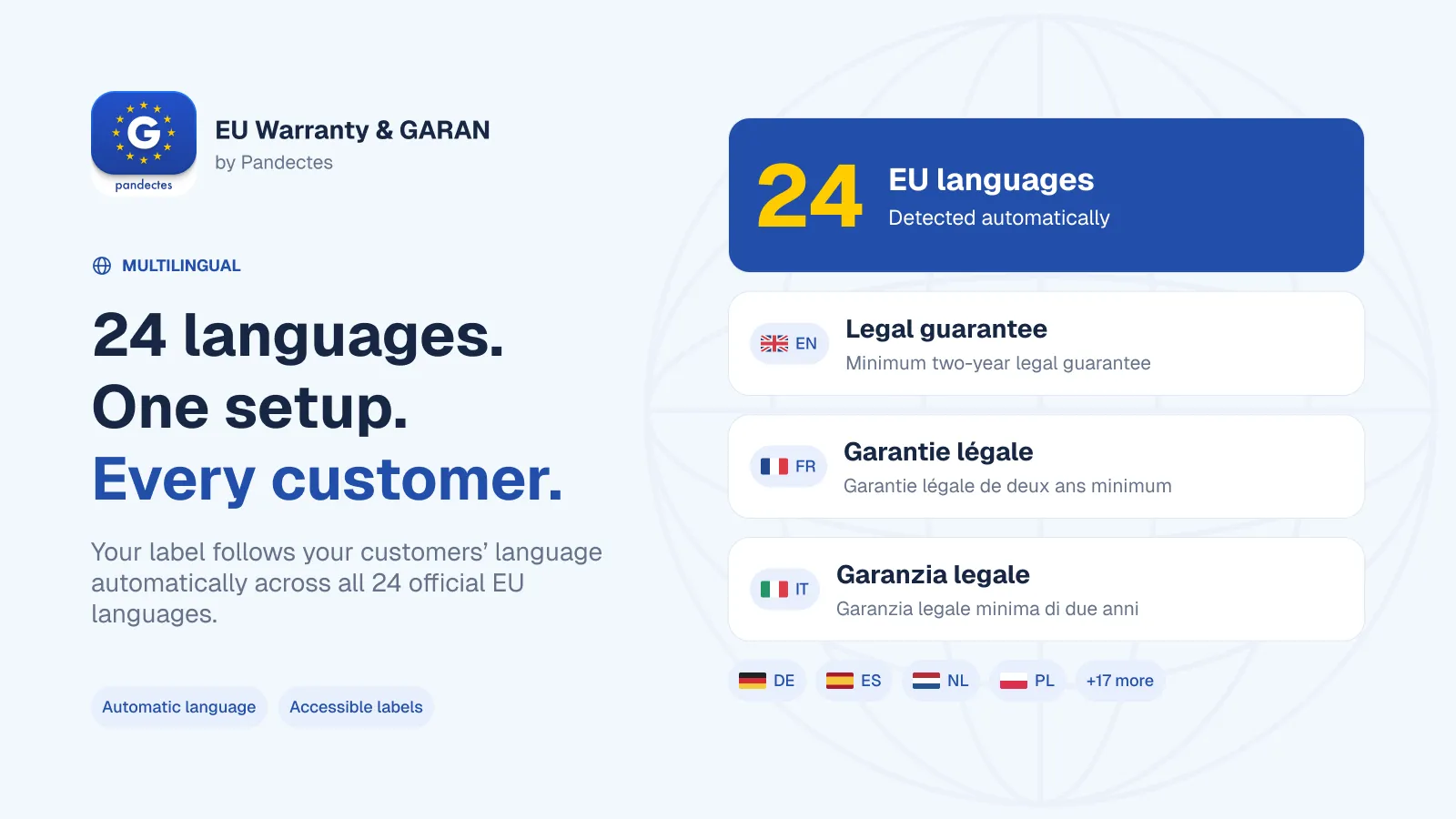
We built Pandectes EU Warranty & GARAN to make this a same-day install rather than a design project. It places the European Commission’s own official artwork on your product pages, matched automatically to the shopper’s language across all 24 EU languages, without you ever redrawing, restyling, or resizing anything. On first launch, it walks you through a setup guide: where the notice goes in your theme, how to sync the official artwork, and how to mark which products carry a qualifying GARAN guarantee.
It also keeps the exclusions correct out of the box: digital goods, gift cards, services, and B2B buyers are excluded automatically. And it gives you a single dashboard to see, at a glance, whether your notice and any GARAN labels are actually live before the 27 September deadline arrives.
The Basic plan is free and covers the legal guarantee notice, a live theme check, exclusion rules, styling options, and GARAN labels on up to 10 products. The Plus plan ($9/month, or $90/year) adds all 24 EU languages matched automatically, unlimited GARAN labels, smart exclusion defaults, custom CSS styling, and cart-page placement, with a 7-day free trial.
Meet the EU Guarantee Notice Requirement Automatically
Pandectes EU Warranty & GARAN places the European Commission's official artwork on your product pages, in the shopper's language, before 27 September 2026.
Install on ShopifyFrequently asked questions
Do I need this if my store isn’t based in the EU? Yes, if you sell to consumers with an EU delivery or billing address. The obligation follows where the shopper is, not where the seller is registered.
Is the GARAN label mandatory for every product? No. It’s only required when a producer offers a free, whole-product guarantee lasting more than two years and has shared that information with you. Most standard 1–2 year manufacturer warranties don’t qualify, and you’re not expected to chase producers for guarantee details they haven’t provided.
Can I just put the notice in my Terms & Conditions? No. That’s explicitly called out as non-compliant. It has to be seen before checkout, not filed somewhere a shopper would have to go looking for it.
Is there a grace period after 27 September 2026? No. The regulation applies directly in every member state from that date, with no transitional period.
Does this apply to digital products or services? No. The legal guarantee of conformity is a goods-specific right, so digital-only products, gift cards, and pure services fall outside it.
What if I sell into multiple EU countries? Each storefront needs the notice in the correct local language. The underlying legal guarantee period can also vary slightly by country, so a single English-only notice across every market isn’t enough.