 Install free
Introduction
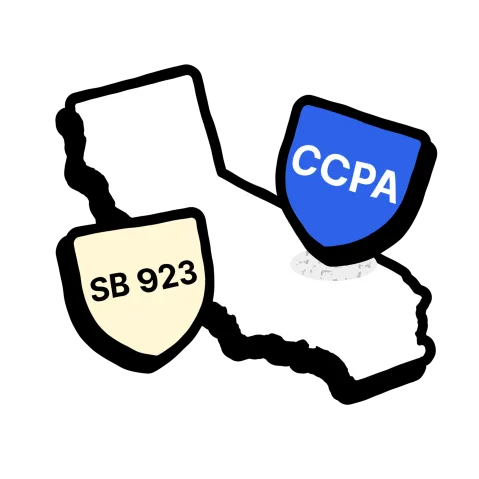
California is tightening its privacy laws again. SB 923, the Expanding Privacy Rights Act, introduces two changes that many businesses-especially those operating exclusively online-need to act on before January 1, 2027. If you sell to California consumers, here’s what you need to know about the new deletion rights, webform requirements, and how to prepare your operations.
SB 923 is a 2026 amendment to the California Consumer Privacy Act, authored by Senator Josh Becker and sponsored by the California Privacy Protection Agency. It focuses on two changes: broadening what deletion rights cover and requiring structured online submission methods for certain businesses. Governor Newsom signed the bill on September 27, 2026, and it becomes operative on January 1, 2027.
The law amends California Civil Code sections 1798.105 (deletion rights) and 1798.130 (methods for submitting requests). Under the CCPA, consumer privacy requests include the right to know, the right to delete, the right to correct personal information, and the right to opt out of sale or sharing. SB 923 changes how two of these rights work in practice.
| Aspect | Before SB 923 | After SB 923 (January 1, 2027) |
|---|---|---|
| Deletion scope | Only information collected from the consumer | Information collected from or about the consumer |
| Request intake (online-only) | Email address alone could suffice | Must provide email plus an online method (web form or portal) |
| Third-party and inferred data | Generally out of scope for deletion | Must be deleted unless an exception applies |
| Suppression records | Not explicitly addressed | Businesses may retain minimum data to prevent re-adding deleted data |
 Pandectes GDPR ComplianceThe most popular & reviewed GDPR app for ShopifyInstall free on Shopify
Expanded Deletion Rights: “From or About” the Consumer
The core of SB 923 is a single word change with major operational impact. Previously, the CCPA gave consumers the right to request deletion of personal information a business collected from them. Now, the law covers personal information collected from or about the consumer-including third-party data, data broker feeds, ad platform segments, and inferred data about behavior or preferences.
SB 923 closes statutory loopholes in data deletion requests that previously let businesses sidestep deleting information obtained from outside sources. Starting January 1, 2027, consumers can request deletion of third-party data, purchased audience segments, appended demographic records, lookalike audience attributes, and behavior-based propensity scores.
Here’s a concrete example: an online clothing retailer buys demographic enrichment data from an ad network-age ranges, income brackets, interest tags like “sustainable fashion.” Under the old law, a deletion request might only touch what the customer directly provided. Now, businesses must delete all appended and inferred data as well. Businesses must identify all personal information about consumers across every system, not just their primary customer database.
This change applies to all CCPA-covered businesses, not just online-only businesses. It directly affects how deletion workflows must be designed, and it means many businesses need to revisit their internal definitions of “personal information” and “information collected” within their privacy programs.

Make Your Shopify Store CCPA & CPRA Compliant
Give California customers full control over their data and opt-out of tracking in minutes.
Get for freeCalifornia SB 923 and Suppression Lists
SB 923 explicitly allows businesses to retain minimal data records-suppression lists-after honoring a CCPA deletion request. The purpose is narrow: preventing a deleted consumer’s profile from being reintroduced through new data feeds, vendor refreshes, or third-party imports.
A suppression record in practice might contain a hashed email address or unique ID, the date the request was processed, the type of request, and a status flag. That’s it. The statute requires this minimum data only to ensure deleted information stays deleted and isn’t used for any other purpose, marketing, profiling, or resale.
Here’s how it works for a Shopify store:
- Consumer submits a deletion request via webform
- Customer data is deleted across all connected systems (e-commerce platform, email marketing, analytics, loyalty apps)
- A hashed version of the consumer’s email is added to the store’s suppression list
- When the store later imports a third-party data feed, records matching the suppression list are automatically filtered out
Businesses must document their legal basis for any retained suppression data and ensure this retention is described in their privacy notices and internal data retention schedules.
The New CCPA Webform Requirement for Online-Only Businesses
SB 923 adds a targeted requirement for businesses that operate exclusively online and have a direct relationship with a consumer from whom they collect personal information. Starting January 1, 2027, these businesses must provide an online request method-such as a web form or self-service online portal-in addition to an email address for submitting requests.
Online-only businesses must provide an online request method by 2027, and an email address alone is insufficient for privacy requests after January 1, 2027. The online method must support requests to know, CCPA deletion, and correction of personal information-not just a single request type.
The rationale is straightforward: webforms standardize how consumers submit privacy requests, guide them through selecting the correct request type, and make verification and tracking far easier than unstructured email threads. The California Privacy Protection Agency has emphasized that structured online submission methods lower barriers for more Californians to exercise their rights.
Email-only workflows will no longer satisfy SB 923 for these covered businesses. Noncompliance may create enforcement and litigation risks that proper preparation can easily avoid.
Designing a Compliant CCPA Privacy Webform
Building an SB 923-compliant request form doesn’t require a massive engineering effort, but it does require attention to detail. Here’s practical guidance for getting it right.
The form should collect only necessary information:
- Full name and email address
- Optional order ID or account number
- State of residence (to confirm California consumer rights apply)
Avoid requesting sensitive fields that aren’t needed for verification. The webform must guide consumers through the submission process by letting them choose their request type, access, deletion request, correction, opt-out of sale/sharing, or limiting use of sensitive information, through clear checkboxes or radio buttons.
Next to the “deletion request” option, include a short explanation of what will happen: impact on the consumer’s account, marketing emails, order history visibility, and loyalty points. This reduces confusion and support tickets.
For identity verification, do not require forced account creation. Instead, use reasonable methods: email confirmation links, one-time verification codes, or matching against an existing order ID. Businesses must confirm receipt of requests within 10 business days.
The confirmation screen and follow-up email should state the 45-day response deadline under CCPA and explain how the consumer can track request history or update their submission.
Data Mapping: Meeting the Wider Deletion Scope
The expanded “from or about” language makes accurate data mapping a central requirement of SB 923 compliance. Businesses must map data pipelines, including third-party vendor information, to understand where consumer data lives across their entire stack.
Key systems to include in a CCPA data map:
- Ecommerce platform (Shopify, BigCommerce)
- Payment processors
- Email and SMS marketing tools
- Analytics and ad platforms
- Customer support and helpdesk systems
- Review and UGC apps
- Loyalty and rewards programs
- Data brokers and enrichment providers
Each consumer deletion request must be propagated to all systems containing information collected about that consumer-not just first-party records. Maintain a living data inventory that documents what data sources exist, where information flows, who processes it, and how deletion is technically performed for each vendor.
Pandectes customers can leverage automated store scanning and integrations to identify cookies, pixels, and third-party scripts that may be collecting consumer data, supporting the data mapping process.

Need a CCPA-Compliant Cookie Banner for Shopify?
Add a Do Not Sell option and meet California privacy requirements automatically.
Get for freeOperational Workflow for CCPA Deletion Requests Under SB 923
In 2027, every CCPA deletion request triggers a documented, multi-step process. Here’s the end-to-end lifecycle:
- Intake: Consumer submits via web form or email
- Log and acknowledge: Record the request; confirm receipt within 10 business days
- Verify identity: Use email confirmation, order ID matching, or one-time link
- Locate data: Search all systems for information collected from or about the consumer
- Apply exemptions: Check whether statutory exceptions (tax records, fraud prevention, legal obligations) apply to any subset of the data
- Delete or de-identify: Remove permitted data across all systems; instruct service providers and contractors to do the same
- Update suppression list: Add minimum data to prevent re-acquisition
- Respond to consumer: Confirm completion within 45 days (one 45-day extension permitted if reasonably necessary, with notice to the consumer)
- Retain request record: Document the request and the minimum data for compliance auditing
The law includes existing CCPA exceptions for data deletion requirements-businesses don’t need to delete data required for legal compliance, fraud prevention, or contractual obligations. But they do need to document which exceptions apply and why.
Assign clear ownership for receiving and triaging consumer privacy requests. Ad hoc handling across departments creates compliance gaps.
Impact on Online-Only Businesses and Shopify Stores
An exclusively online business transacts entirely online and has no consumer-facing physical locations to intake requests. This describes a large percentage of Shopify merchants, particularly DTC brands that have a direct consumer relationship through their storefront.
These Shopify stores must implement a CCPA webform or portal by January 1, 2027. Even businesses that believe they only collect customer data directly must still comply with the webform requirement if they operate exclusively online with a direct relationship.
Specific challenges for smaller ecommerce brands include:
- Limited legal resources to interpret the new law
- Multiple marketing integrations (email, SMS, retargeting) that each hold personal information
- Heavy reliance on third-party Shopify apps for reviews, analytics, and loyalty-each of which is a data source that deletion must reach
Deletion requests may affect account functionality, loyalty points, and marketing personalization for returning customers. Consider adding proactive consumer-facing explanations on your webform or privacy policy page about what deletion means for their shopping experience.
Building SB 923-Ready Privacy Programs with Pandectes
Pandectes helps Shopify merchants operationalize SB 923 and broader California consumer privacy obligations without replacing legal counsel. The platform provides multilingual cookie banners and consent management aligned with CCPA, CPRA, GDPR, LGPD, and other privacy laws, centralizing consent signals for consumer rights handling.
Merchants can configure a dedicated CCPA privacy webform linked from their privacy policy and site footer, routing requests into consistent internal workflows. Store scanning and data discovery features help identify third-party scripts and integrations across the ecommerce stack, supporting accurate data mapping and deletion procedures across connected apps.
Pandectes reduces operational burden, helps document compliance steps, and keeps Shopify stores aligned with evolving US and global privacy laws-all from a single platform.
Practical SB 923 Compliance Checklist
Use this checklist to prepare before January 1, 2027:
- Update privacy notices - Describe expanded deletion rights covering data collected from or about consumers, list all available request methods, including the new online way to submit
- Implement or upgrade your CCPA online request form - Ensure it covers access, deletion, and correction requests; test the full path from submission to response
- Complete data mapping - Identify all third-party and enriched data sources; document how each system handles a CCPA deletion request and what information obtained from vendors exists
- Revise vendor contracts - Ensure service providers and contractors are obligated to delete, suppress, and notify downstream parties when a deletion request is received
- Train support staff - Ensure customer-facing teams recognize and correctly route consumer privacy requests arriving via webform, email, or other channels
- Set up suppression-list procedures - Define what minimum data is retained, how it’s secured, and how it’s applied to future data imports
- Log and track deadlines - Maintain request history with timestamps, actions taken, and outcomes that can be demonstrated to regulators if needed
Conclusion
SB 923 significantly expands California consumer rights under the CCPA by broadening deletion rights to include personal information collected from or about consumers, including third-party data. It also imposes a new requirement for online-only businesses to provide a structured online method, such as a webform, for submitting privacy requests starting January 1, 2027.
Businesses must prepare by updating their data mapping to cover all sources, implementing compliant webforms for secure delivery and easy consumer submission, and establishing operational workflows that honor deletion requests while retaining only the minimum data needed to prevent reintroduction of deleted information. By proactively addressing these requirements, Shopify merchants and other online businesses can ensure compliance, build consumer trust, and avoid enforcement risks under California’s evolving privacy landscape.